




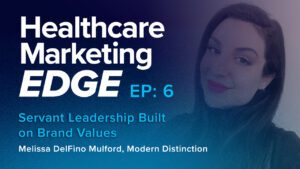
 In this episode of Healthcare Marketing Edge, Tim Bouchard and Melissa DelFino Mulford, Founder of Modern Distinction discuss the significance of servant leadership in healthcare practices. They explore how core brand values and mission contribute to building quality teams, emphasizing the importance of empowering staff and creating a positive patient experience. Melissa shares insights on how to implement effective management strategies, the necessity of clarity in leadership, and the benefits of establishing a strong foundation for practice growth. The conversation highlights the role of team dynamics in achieving success and maintaining high standards in patient care.
Tim Bouchard (00:00)
Welcome to Healthcare Marketing Edge, where we share stories and strategies to grow your practice. I’m Tim Bouchard from Luminous, a healthcare marketing agency specializing in helping practices acquire patients and grow their practice. Today, we’re exploring how servant leadership and core brand values and mission contribute to building quality teams. Our guest is Melissa Del Fino, practice management consultant and founder of Modern Distinction. And she’s a pro at empowering staff and balancing work life for practice owners. And Melissa, I’m glad you wanted to come on.
this is awesome, why don’t you introduce yourself and tell everyone a little bit more about who you are and what you do.
Melissa DelFino (00:34)
Yeah,
absolutely. Thank you for having me. I’m super excited to be here. ⁓ So I’ve been in the healthcare field for over 12 years now. It’s kind of doing every role. ⁓ I actually started out as a appointment secretary working in a call center and noticed that there were so many issues with kind of just streamlining operations and micromanaging and not having clarity in the role.
and kind of just like worked my way up into a supervisory role. And this is all during my master’s program in psychology. So it’s like, how do we, yeah, how do we incorporate psychology and leadership? And I think that’s like such a big deal in the field. ⁓ When you’re working directly with business owners like doctors, you know, there’s not much room for business and administration when you’re learning.
Tim Bouchard (01:10)
fun.
Melissa DelFino (01:31)
the ins and outs of dermatology. So when they open practice, there’s kind of that gap there. And that’s where management comes into play. And how do we navigate that?
Tim Bouchard (01:33)
Mm-hmm.
Yeah, how, you know, then you also you got modern distinction set up too. Why don’t you talk a little bit about how you help people to like give us the high level and then we’ll dig into some other stuff, you know, more deeper into the servant leadership and things like that.
Melissa DelFino (01:48)
Yeah.
Yeah, so modern distinction is something that I came up with. actually just launched it in ⁓ March and I we’re currently building out a platform, but I am offering strategy sessions while we’re still building that out. But essentially it’s guidance for doctors and business owners and their management team to kind of better understand how servant leadership can be incorporated in their practice because
your front desk and your entire team are your, they’re essentially your marketing strategy. If they’re not aligned with your vision and your values, then patients walk right out the door and they won’t come back. So you want to optimize the ROI on your staff since they’re your biggest expense.
Tim Bouchard (02:45)
Yeah, a lot of people automatically jump to the marketing side, being the outward communications aspect, but everyone has to remember, and this is true in the product side as well, if you don’t have a good product or service or experience, you can communicate the heck out of the fact that you exist. But if someone shows up and it’s a poor experience or a poor outcome, you know, so that’s where the team and the structure of the…
the organization and everything really comes into play to make sure it’s a high experience along the way, for sure.
Melissa DelFino (03:16)
100%.
And that even starts as early as the first phone call interaction that they have. ⁓ So being sure to have etiquette ⁓ training for your front desk staff and ensuring that they have all of the guidelines that’s necessary to deliver that experience from that first touch point is so crucial.
Tim Bouchard (03:38)
Yeah, so let’s dig into some of the things that that you like to help people with. The first one and the obvious one is the servant leadership side of things. So what about that is what’s the struggle that you’ve seen, ⁓ practitioner owners and leaders in practices see that kind of was the genesis for you saying, I think I can help reframe this for everyone. That’s where the servant leadership ⁓ strategy and consulting came into play.
Melissa DelFino (04:06)
Mm-hmm. So servant leadership in general like what it is is how do we support our employees? And their vision and they’re basically how to do their job ⁓ during part of my interview process when I’m initially hiring I I asked the questions. What are your goals? I see you’re currently in school What do you want to do with your life? You know, like a lot of the times business owners think they’re just hiring for a job
but you’re investing in a person. So you wanna make sure that they’re supported and how can you actually get them there? So that’s one of the things I incorporate, at least in my interview process when I’m ⁓ interviewing for a practice I’m working for, but also how do we teach management to ask those questions and where can we find ways to invest in the employee?
Tim Bouchard (04:58)
Yeah, inspiration from those things really do come from like that initial setting of what the mission of the practice is. Why was it even set up in the first place? Do they believe they have a certain level of care that no one else does? Do they believe they have a process or a way of working with people that is different? And starting there too, then people know what they’re getting hired into, or if they’re a patient, what they’re signing up for. And if you can’t bring people in that match that from a team standpoint, or if you
someone has potential but you don’t have the leadership skills to ⁓ nurture that in them, then you’re kind of at a dead end.
Melissa DelFino (05:36)
Right. And even on an education standpoint too, so many practices do different things. how do we kind of measure is the potential employee interested in even learning that? Front desk especially is something that is not just a desk job. They are the first person that are speaking to patients, so they really do have to be educated. They’re not just making appointments and kind of checking in and out.
Tim Bouchard (05:51)
Mm-hmm.
Melissa DelFino (06:05)
they also have to be pretty well versed on what the procedures are and how do we get them to the appropriate provider to best meet their needs.
Tim Bouchard (06:15)
Yeah, and some of this even.
You know, when you think about just putting up job postings, we’re kind of going back to hiring and recruiting at this point, too. But to build the right staff, you have to have the right people and how you communicate those job postings, even in the words that you use or the language that you’re you’re putting out there or what’s included in it. That’s a big deal, too. You can do a lot of filtering of people that might not be aligned just by having the right job posting put out and the right copywriting, the right voice and tone in that. And you can also get a lot of
Melissa DelFino (06:44)
Mm-hmm. ⁓
Tim Bouchard (06:47)
excitement from people if you do it the right way too. They come in hot, they come in warm, and you can have probably an easier conversation on that. Where are you looking to go with your career? Why are you interested in this type of work? Because they’re primed up for it based on what you put out into the world.
Melissa DelFino (07:02)
100 % a lot of the times when I’m drafting job postings I’m making sure we’re putting something that’s aligned with growth opportunity and What I find with a lot of small private practice is there’s not much of that So it’s like how do we build growth opportunity for employees and when you are looking at resumes and you see that They’re kind of going job to job like on a yearly basis Why why is that and a lot of the times what I find is that?
they’re leaving small practices because there’s nowhere else for them to grow within that company.
Tim Bouchard (07:37)
Yeah, and speaking of growth, it really is, it’s leadership driven, but it’s really…
It happens when the underlying team and support system comes through like the leadership obviously will have motivation to want to grow a practice or or provide a certain experience. But without the team actually buying into that and doing it, you won’t see the growth opportunity because there’s things we’ll talk about later. This factors into patient reviews of the practice itself, perhaps patient reviews of the practitioner themselves on some of the practitioner review directories.
Melissa DelFino (08:01)
Mm-hmm.
Mm-hmm.
Tim Bouchard (08:16)
And, you know, making sure that the leader has their own world in order. And that aligns with the brand and business that they’ve set up as a practice goes in that too. So why don’t you shift a little bit to how you help leaders gain some clarity and focus in what they’re doing too.
Melissa DelFino (08:35)
Yeah, for sure. So I think the first step is kind of what is the vision and what do you want for your patients and how can we be intentional with providing the experience that we want. like, for instance, one of
the practices that I work for, we have a cappuccino machine, right? So something as simple as like offering a cup of coffee while they wait, or if we’re rooming them and we know that there’s going to be a little bit of away time, it’s like a nice buffer, but it’s also providing that enhanced experience that especially, you know, not just in aesthetics, but in a medical setting, patients are not expecting that. So they feel like they’re being catered to in a nice warm way. And, you know, we find that
Tim Bouchard (09:14)
Mm-hmm.
Melissa DelFino (09:20)
If you do too much, it gets too messy. it’s working with leadership. You want to outline, let’s do like two main things that we can get the staff consistent on and then provide those guidelines and how do we incorporate it in their day to day. So it seems very intentional and just has a nice flow.
Tim Bouchard (09:41)
Yeah, I’ll do a name drop here. ⁓
What that kind of reflects is ritualistic branding, right? You’re giving someone a unique thing that your practice organization does that gives them an experience that’s unlike other people. So yeah, it’s a small cup of coffee or a certain type of visit from one of the staff or something like, or the way that a phone is answered or called back or something. They seem little, but they’re little, these are rituals that are unique to the practice itself. So let’s call it that.
Melissa DelFino (09:56)
Right.
Right.
Tim Bouchard (10:12)
If anyone wants to look into it, it’s a very cool book. called Primal Branding. It’s like maybe 10, 15 years old by Patrick Handel. It’s a very fascinating read on the idea of using ritualistic and like very vision and focused based branding on creating experiences, which I think applies a lot in the health care space because it’s all built on trust. It’s all built on confidence.
Melissa DelFino (10:33)
100 percent.
Tim Bouchard (10:38)
So those little touches are great, but you mentioned something. You mentioned the leadership setting the stage for the team to be the ones to be able to provide that.
Melissa DelFino (10:51)
Right. So that’s where you want that clarity, right? So a lot of the times what I find is business owners are in all these like Facebook groups and they get all these ideas and they want to implement everything at once. So that’s where there’s that analysis paralysis and the staff sometimes are just not clear with like, what do you want us to do? So working alongside the
Tim Bouchard (11:06)
Mm-hmm.
Melissa DelFino (11:16)
managers and the business owners to kind of really like get that set in stone and say we’re going to stick to this and let’s see if it works before we make any changes. This way we can have all of ⁓ you know the steps in place and in writing where when we are doing staff onboarding they already know what the standard is, what is the mission, and this is what we need to deliver.
Tim Bouchard (11:40)
Now I feel like the smaller the practice, the higher the likelihood that there’s a trap that the practitioner owner might hold on to a lot of this stuff more than they probably should.
Melissa DelFino (11:49)
Yes.
I think that’s where too, ⁓ from what I’ve found is when you have like a solo practitioner that’s just trying to run their own business, they feel that they might not even need a manager. And that’s where I see a lot of the hiccups come in where they’re asking for my advice, but like, you know, if I’m working with them directly, it’s now up to them to execute it. And they’re seeing patients all day. So it’s, it’s, that’s a really difficult thing to navigate. So
kind of giving them the guidelines and what modern distinction is, online platform where they will have staff training, practice management strategies, as well as ⁓ kind of just having all that set in stone. What it…
is in the future what’s being built are online modules where the staff will do basically all of their onboarding and then they get a certificate of completion at the end and we have all of our ducks in a row but it really is up to someone whether it’s management or the practice owner to ensure that that’s being done and then we have those multiple touch points to make sure everyone’s on the same page.
Tim Bouchard (13:04)
And yeah, so think about putting that stuff together, right? You have very good SOPs and onboarding. You have very clear mission purpose values. And then you put those two things together. If you’re looking for a way to feel confident about downward delegation or the ability for the team members to believe in what you’re trying to establish at the practice, having both sides of that equation is super important.
Melissa DelFino (13:31)
very important. ⁓ One of the things I find too is if a practice owner has so much faith in one employee, we’re essentially burning that one employee out because we’re going to them for everything because we trust that the job is getting done. But empowering your staff is making sure that all of them know what
One, what are the expectations? And two, how do we deliver that same experience and educate them? So ⁓ we don’t try to burn staff out by doing that. We want to make sure we’re delegating. I try to rotate. From some of the practice I work at, we rotate responsibilities on a weekly basis and make sure that everyone has a hand in it so that they know the ins and outs of a practice.
Tim Bouchard (14:22)
So all this stuff gets set up. You’re setting.
owners and team members on the right path. They’ve got resources. They’ve got some clarity. How are you helping people or advising people to make sure that it’s getting enacted the right way, that the quality stays up? there ways to measure this or are there strategies to nurturing it and cultivating it and making sure it doesn’t drop off? You know, if I was to put out an analogy ⁓ that we’ve all probably experienced, a brand new restaurant opens up, you go to it, it’s like the best experience you’ve ever had. You’re like, wow, I’m going to come back.
here and you come back eight, twelve months later and the staff’s completely turned over, the service is completely different and they’ve modified the menu down. Like how do you avoid something like that happening in such a an intimate trust based exchange between patients and and staff and their care?
Melissa DelFino (15:03)
Mm-hmm.
For sure. So with modern distinction, we also have retainer options where we are doing, you know, whether it’s monthly or quarterly based on what the doctor or owner wants. We’re doing strategy sessions to just make sure we’re like keeping everything in place and, you know, show me your employee handbook. Let’s see. Have you already established your core values? Has everyone done their certificate of completion? Had gotten their certificate of completion? And then kind of reviewing too.
financials, how do we measure KPIs, are we getting new patients in. ⁓ So helping practice managers and the owners monitor to those things will help determine that they’re following.
Tim Bouchard (15:59)
Yeah. And internally even, I guess from perhaps like a review or coaching or mentorship standpoint is there’s probably some element, even though a lot of things have been delegated or have gone into SOPs and have been educated and communicated the right way to the team, there’s probably still some involvement from the leadership in making sure that they’re touching base, at least with key team members. I’m sure. mean, the smaller the practice, probably everyone, but
Melissa DelFino (16:23)
Mm-hmm.
Tim Bouchard (16:26)
You know, even with the delegation, it’s opened up maybe some time for that type of thing versus the actual like execution themselves of these activities.
Melissa DelFino (16:35)
Yeah, what I find is, you know, I used to work for a practice where we had Mondays like a half day. So we would always do like a touch base on Monday. Some practices that are larger with multiple locations that is extremely difficult to navigate. So if you do it departmentally, then it’s it’s better that way. Or even doing just like text check ins not not everyone is available at the same time, unless you’re blocking out time, which
Tim Bouchard (16:45)
Mm.
Melissa DelFino (17:05)
can be costly for a practice. ⁓ But my office at the practice I currently work at is like, I have a therapy couch. So I’m always inviting people in and I’m like, tell me what’s going on? What’s frustrating you? Like, how can I help you? What’s the craziest thing that you’ve seen this week? And how can we navigate it for the next week? like, also having those individual conversations with employees is super important.
because especially if it’s just owned by the doctor and they’re managing it all, they don’t have the time to do these like elaborate staff meetings. And sometimes those feel like hostage situations. So the staff don’t always want to be there or they feel like they’re in trouble. So having that space to give them ⁓ just the opportunity to vent even is super important. I used to do an exercise called Rosebud Thorn.
and kind of say, know, what is a highlight from last week? What is something you’d like to learn and what is something that frustrated you? And just, you know, those three questions, staff are extremely enthused to answer.
Tim Bouchard (18:16)
Yeah, culture of learning and always want and that, you know, when you’re talking about growth path for the practice that opens up growth path for the team and you have to. ⁓
actively work that like growing plants in a field or whatever you want to say, you know about that. So it’s very culture based and it and like we said at the beginning, it’s it’s very top down and you know, so, you know, all of this stuff gets in motion. What are some of the benefits you’re seeing for leadership or for practices by going after it this way and starting with a good foundation and then building the systems and belief values to put towards the team?
Melissa DelFino (18:30)
Yep.
for sure.
⁓ what I find is that when you do have these things set in place, it kind of allows the business owner to kind of take a step back and they can also emotionally regulate, which is not like a common thing. People know like it takes work. It takes time. And when you’re running a business, you don’t really have the time to do that. So I’ve, they’re very reactive. Sometimes management can be very reactive sometimes in the midst of chaos.
So, you know, having all of this set in place and having faith in the team that they are able to execute it and then witnessing it, you know, be present so you can witness that it is getting done and implementing patient retention options that are either like automated or even having your staff say, if you love the service you had today, please write us a Google review. Having something like that, just these minor things that are very intentional.
Tim Bouchard (19:42)
Yeah.
Mm-hmm.
Melissa DelFino (19:54)
can make a huge difference.
Tim Bouchard (19:55)
Yeah, if you were to go
back to what I said at the very beginning, sometimes we think to skip ahead to the outward communication without getting the house in order. And a lot of you could, you can get a lot of good ad placements or creative or, you know, search visibility, whatever you might say. But if someone looks one step deeper into it and there’s little to no reviews or poor reviews or, you know, maybe something a little bit more.
Melissa DelFino (20:04)
Mm-hmm.
Tim Bouchard (20:23)
I don’t know, like vain, like the website looks disorganized or it’s hard to find information or it’s hard to find a phone number or a contact form, whatever it might be. There’s too many points of friction. And in the trust business, you can’t start with friction and frustration. You have to start with ease and, you know, and bring people in that way.
Melissa DelFino (20:28)
Right.
100 percent.
Tim Bouchard (20:47)
Is there anything that I haven’t asked you that you’re just dying to say that hasn’t come up in the conversation so far?
Melissa DelFino (20:55)
my goodness. ⁓ no, I feel like, I feel like we did pretty good. ⁓ I mean, honestly, at this point, I do feel like, you know, any of your listeners, I’m open. If anyone’s in that, you know, healthcare space, I would love to give you a free 15 minute strategy session that we can kind of connect and see, you know, I work in healthcare, but this really applies to any business.
Tim Bouchard (20:59)
Yeah, we did good.
Melissa DelFino (21:24)
So prior to healthcare, I worked in the restaurant business.
Tim Bouchard (21:29)
that’s funny, I did that analogy then.
Melissa DelFino (21:31)
Yeah, exactly. So,
you know, I recently went to a pub and it was, it’s funny, the owner was a podiatrist and his wife ran the bar downstairs and he like came up to me, I’ve never seen you before, introduced himself and then at the end of the night walked us out. And I was like, that was so intentional and like beautiful, you know, so I’d love to work with any, anyone. Let’s definitely connect.
Tim Bouchard (22:01)
Well, in that vein, this has been great. You want to tell people where they can find out about you and modern distinction.
Melissa DelFino (22:07)
Yes,
yes. So it’s modern distinction.com and I’m also on Instagram modern distinction consulting.
Tim Bouchard (22:17)
Cool. Well, yeah. And LinkedIn too. I mean, I’ll have you linked up and LinkedIn too for the episode as well. Yeah. Cool. Well, this has been great. ⁓
Melissa DelFino (22:18)
I’m not in the same. I’m LinkedIn, that’s how you got me. Yes.
Tim Bouchard (22:27)
All listeners, if you want to take your practices brand and patient recruitment to next level, you could also take advantage of our patient pipeline blueprint, which is an offer that you can go to luminus.agency slash blueprint. It’s a workshop to uncover how you can attract new patients, convert more inquiries into appointments for your practice. If you want to hear or watch more content like this, you can subscribe to Healthcare Marketing Edge on Spotify, Apple, or watch us on YouTube for more episodes. thanks a lot, Melissa.
coming on and this was great. Yeah.
Melissa DelFino (22:55)
My pleasure, thanks for having me.
Get Your Tailored Patient Pipeline Blueprint
A 2-Hour Healthcare Marketing Consultation to Attract, Convert, and Retain More Patients Guaranteed!
Imagine a practice where new patients book appointments every week and your current patients keep coming back. The Patient Pipeline Blueprint turns that vision into reality.